
From answering questions to doing a task for you
Ask the AI to explain a term; if it answers incorrectly, you can check it back. But if you ask it to modify an order or fix a website, errors could affect accurate information. As the scope of the task changes, the usage method must also change.
Here are six ways to organize the division of labor for easy reference. This is not an official rating system, nor does it require everyone to pursue full automation. The amount of authority granted and the amount of review required are determined by the task at hand.
| Hierarchy | Tasks assigned to AI | Primary Responsibilities of a Person |
|---|---|---|
| I. Questioning and Understanding | Explanation, Organization, and Comparison | Judging the Credibility of Problems and Information |
| II. Collaboration and Output | Drafting, Design, Analysis, and Programming | Defining Quality and Direction of Modification |
| III. Establishing Workflows | Completing Repetitive Tasks Step by Step | Designing Processes and Acceptance Criteria |
| IV. Connecting Tools and Data | Reading Data and Operating External Systems | Managing Data Sources and Access |
| V. Delegating Task Execution | Planning, Execution, Inspection, and Adjustment | Setting Goals, Limitations, and Stopping Conditions |
| VI. Integrating into Organizational Decision-Making | Supporting Cross-Departmental Collaboration and Decision-Making | Taking Responsibility, Evaluating Effectiveness, and Governance |
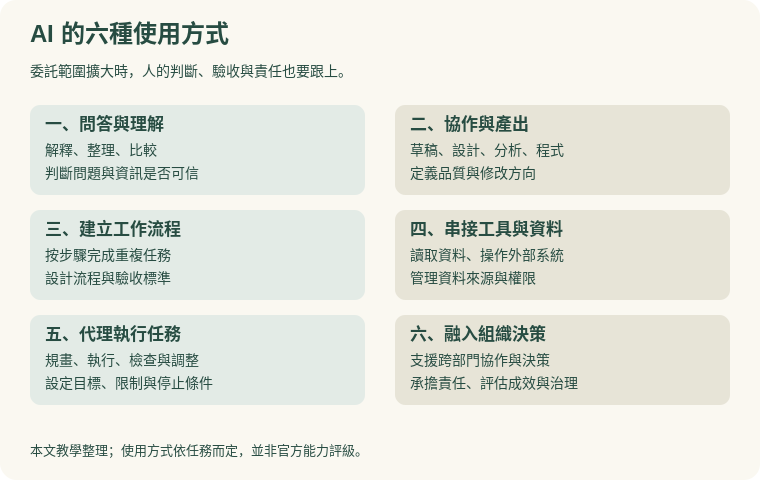
From Q&A to co-production
"How to do marketing?" can provide many directions, but not all are applicable. Add product, target audience, budget, and goals, then ask the AI to explain or compare approaches to determine the suitability of the answer.
Even when the answer is affirmative, follow up with questions about the basis, supporting conditions, and missing information. Verify important facts against their sources; don't mistake confident tone for evidence.
Practice this:Ask the AI to summarize an article, listing the claims, evidence, and unanswered questions separately, then compare it to the original text to see if any limitations were missed.
Working together to complete a work
Before letting the AI draft articles, create diagrams, or write programs, explain the intended use. The intended audience and sources of an article, as well as the website's intended audience and user experience, will all influence the required outcome.
Upon receiving the first draft, directly point out any inconsistencies in its intended use. For example, "This section is missing an example" or "The submit button is not visible on the mobile phone" will guide the next revision.
Appearance and functionality should be checked separately. An article may read smoothly but still lack evidence; a website may appear complete, but forms may not have been accessed from the database.
Practice this:When writing an event invitation, first state the target audience, purpose, and tone, then verify the date, location, and registration method.
Integrating methods and data into the work
If the same type of work is repeated, record the effective steps. For example, when researching an article, first confirm the title, collect sources, organize theoretical points, then draft, check, and publish; at each step, know what was received and what was delivered.
Sample templates, checklists, and skills can be used to save methods. Here, "skill" refers to reusable task instructions, with support methods varying depending on the tool; instructions must be updated as needs change.
- If reliable information cannot be found: narrow your claims or stop writing.
- Conflicting Sources: Present discrepancies to avoid forced merging.
- Failed Check: Return to the previous step for modification, retaining the reason.
Insufficient data, conflicting sources, or failed checks: Know which step to return to. The process only dictates progress; previous errors will also be included in the final product.
Practice this:Create a fixed format for weekly summaries, attaching sources to each conclusion, and leaving a "to be checked" column for missing data.
Connecting Data and Tools
After connecting to databases, spreadsheets, or business systems, AI can handle actual work and more easily influence real data. First, ask if the data is correct, then ask if the operation is authorized.
Customers with the same name may be different accounts, and old orders may have already been refunded. Being able to query doesn't mean you can get a refund, and being able to make suggestions doesn't mean you can make changes; permissions and actions that require confirmation must be listed item by item.
Queries must be source-aware, and modifications must be based on records. In particular, inconsistencies in field definitions, update times, and account identification should not be discovered only after the connection is complete.
Practice this:First, read the test order table and let the AI provide suggestions for improvement. Only authorize modifications to the specified scope after confirming its understanding of the fields.
Responsibility after expanding the scope of execution
Pre-defined workflows follow a predetermined path; agents can select tools and adjust the next step based on the goal and result. Anthropic's engineering articles also use this difference to distinguish between workflows and agents.[1]
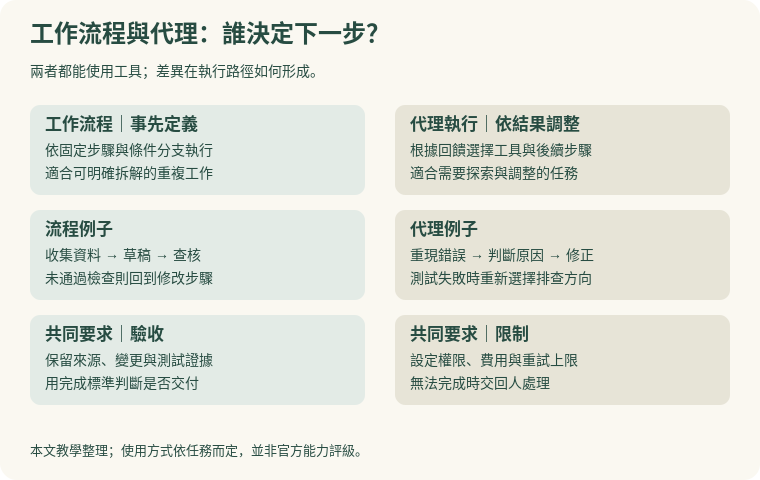
For example, fixing a website form might involve first reading the code, or reproducing the error, checking the request, and then deciding where to modify. If the first fix fails, the cause must be found again.
- Completion criteria: How to prove the problem has been solved?
- Scope of operation: Which files, data, and systems can be modified?
- Resource Limits: How much time, cost, or number of retries can be used?
- Stop Conditions: Under what circumstances must the issue be returned to the responsible person?
First, write down the scope for modification, proof of completion, resource limits, and stop conditions. Agents can adjust the path, but must stop at the boundary and return to the person with the authority to make the decision.
Practice this:Given a limited testing environment and editable files, please have AI fix a minor issue and submit the changes, test results, and unconfirmed items.
Team Adoption and Decision-Making
When AI reads market, customer service, and sales data simultaneously, suggestions will cross across different departments. Business focuses on closing deals, customer service focuses on problem solving, and the product team also needs to assess development burden; these goals may not be aligned.
Someone must be responsible for selecting metrics, accepting trade-offs, and adopting suggestions. If a suggestion is incorrect, the team must still know who is responsible for handling it.
- Have errors and rework increased?
- Has the workload of manual review decreased?
- Has the customer experience improved?
- Does the team still retain the ability to identify errors?
Before importing, record the original working hours, quality, and cost, then see if the new process truly saves overall work. If output increases but subsequent error checking and rework increase, adjustments are needed.
Practice this:Select a small task in a department for trial, assign a person in charge, record successes and failures, and then decide whether to expand.
Choosing a frequently done task as an example
Start with a task where the results can be verified. Explanations and drafts may only require Q&A or collaboration; the steps are fixed before creating the process, real-time data is needed for connection, and the delegation is only evaluated when the path cannot be pre-written.
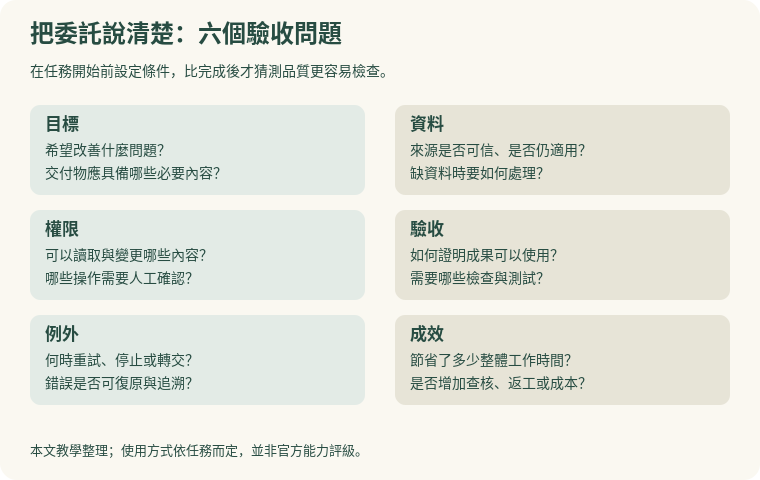
Before starting the next task, write down what evidence you want the AI to return. If even this is unclear, the scope of delegation should be smaller first.
Data Sources and Further Reading
- Anthropic: Building Effective Agents (Distinguishing Between Workflow and Agents)
- MoMA:Piet Mondrian,1872–1944
The six-tier classification, exercises, and assessment suggestions are a teaching summary for this article; they are not the grading standards published by the aforementioned institutions.