From browser development environment to Agent and deployment, breaking down how Replit shortens the application development process, as well as the responsibilities for cost, permissions, and official launch.
From the Cursor editor to the Agent workflow, breaking down how Anysphere integrates AI into software development, and the challenges of payment, security, and acceptance.
From search to the Wenxin model and Qianfan platform, this article analyzes how Baidu integrates AI into enterprise services, and the limitations of import, data, and cost.
From Kimi's long context to its models and APIs, this article analyzes how Moonshot AI serves knowledge work, and the trade-offs in versioning, cost, and licensing.
From e-commerce and Alibaba Cloud to Qwen, this article analyzes how Alibaba integrates models into enterprise workflows and the business relationship between open weights and cloud services.
From Photoshop generative color fills to brand-customized models, this article analyzes how Adobe integrates AI into the creative delivery process, as well as the limitations on usage, licensing, and quality.
From digital portraits to multilingual teaching materials, this article analyzes how Synthesia shortens the redesign process for enterprise training videos, as well as procurement costs and usage limitations.
From multilingual dubbing to interactive voice assistants, breaking down how ElevenLabs integrates voice generation into content creation and enterprise services.
From community creation and style references to GPU subscriptions, breaking down how Midjourney turns repeated attempts into work that designers are willing to pay for.
From Gen-1 to generated video and developer APIs, breaking down how Runway allows model-generated clips to enter an acceptable video production workflow.
From cloud data warehousing to Cortex, we break down how enterprises can incorporate classification, summarization, and natural language queries into their existing analytics workflows.
From Spark and MosaicML to model deployment, breaking down how Databricks enables enterprises to develop AI using data, permissions, and evaluation methods.
Starting with Watsonx's models, data, and governance tools, breaking down how enterprises track model versions, deployment acceptance, and redesign responsibility.
From AWS's launch of Bedrock to its own model Nova, we break down why enterprises are willing to use the same platform to select and manage different models.
From Microsoft Graph, Microsoft 365 Copilot to Copilot Studio, see how models are integrated into existing work and how enterprises measure the value of their purchases.
From WSE-3 Wafer-Level Design to Inference API, understand how Cerebras shortens the distance data travels between computing cores and makes speed a product customers are willing to pay for.
From Mixtral's expert hybrid architecture, see how the French model company is positioning itself across open weights, cloud APIs, and enterprise deployment.
Use Three Signals to Determine if LINE and Excel are Sufficient for Managing Approvals, and Understand When to Use Off-the-shelf Tools, When to Inquire About Prices, and How to Accept the First Version.
From organizing meeting minutes and checking schedules to updating to-do lists, understand how MCP connects AI to external data and tools, and the division of labor between AI Agents, MCPs, and the actual system.
From finding clients and completing projects to managing stores, break down why AI can sometimes perform a single step but struggles to complete an entire task independently, and how businesses can get started.
When AI moves from organizing information to purchasing and payment, how should businesses set budgets, authorize, approve, and track it to enable agents to act while also ensuring human accountability?
From brand positioning and fixed recognition to generating materials and series of reviews, this article analyzes why AI-generated images easily lose consistency and establishes a visual work method that can be used across personnel and channels.
This article analyzes the data, parsing, retrieval, and answering of questions in AI enterprise Q&A, explaining how document version, context, permissions, and testing affect the reliability of the answers.
From accommodation inquiries and manufacturing inspections to system integration, this article breaks down how AI connects with industry data, operational permissions, and human intervention, and measures the overall implementation results.
From payment requirements, project acceptance, and product models to delivery standards, cost calculations, and renewals, this article breaks down how AI monetization progresses from the first order to a continuously deliverable business.
AI allows companies to accomplish more work with fewer people; what will those no longer employed do for a living? "Human Bubble" refers to the gap left by declining labor demand and the resulting gap between income and social arrangements.
Why are there such large price differences for websites called membership websites? Break down the scope of work from common functions, then compare the total price, working hours, phased cooperation, and monthly fees to clarify what the fees cover.
After the form displays "success," is the data actually saved? Use a photography workshop registration as an example to trace how the front-end, API, back-end, and database are connected, and handle full quota, resubmission, and overdue issues.
Asking AI a question, asking it to complete a project, and letting it operate an operating system are different tasks. Six working methods are used to clarify what permissions to grant and what judgments to leave at each step.
From Benz's three-wheeled cars and Bertha's long journeys to the Mercedes name, the 1926 merger, and safety engineering, tracing how the three-pointed star has accumulated its current recognition.
How do seats, chips, batteries, and raw materials make up a Mercedes-Benz? This article examines the division of labor between automakers and suppliers through publicly available cooperation cases, clarifying the difference between supply agreements and actual mass production.
What exactly did the hundreds of billions of dollars mentioned in factory construction news buy? This article breaks down publicly available investment cases into factory buildings, equipment, shared facilities, and pilot production, avoiding mistaking the total cost of the industrial park for the cost of a single factory.
Where do photoresist and polishing slurry come from? By following IBM's reaction design, Inpria's thin film research, and CMP formulation experiments, we can see how a material idea can be transformed into a usable process.
After copper is filled into the trenches, the excess needs to be polished away, while the remaining portion must not be damaged. From polishing slurry and padding material to cleaning, see how CMP achieves control between chemical reactions and mechanical removal.
Metal oxide photoresist is not simply adding metal powder to traditional photoresist. From tin oxide clusters and thin-film imaging to baking atmosphere, see the material design and integration challenges of MOR.
Optics delivers the pattern to the wafer, and photoresist then transforms the exposure into a processable shape. From positive and negative mapping, chemical amplification to EUV defects, understand the work this thin film accomplishes.
A mirror may be very bright, but its shape may still be incorrect. Starting from roughness and surface shape errors, let's see how computer-controlled polishing, ion beam shaping, and measurement correct the mirror surface round by round.
High-NA needs to project finer patterns, but requires a larger optical system. From multilayer films and curved surface processing to measurement, let's see why ZEISS's EUV mirrors are difficult to make.
ASML started as a joint venture in 1984, relying on product platforms, dual wafer stages, and long-term cooperation to reach EUV. Following several turning points, let's see how equipment has moved from R&D to mass production.
How to move the platform accurately? How to keep water in the exposure area? How to control light source debris? Understanding some engineering details of lithography machines from the questions and requests of three published patents.
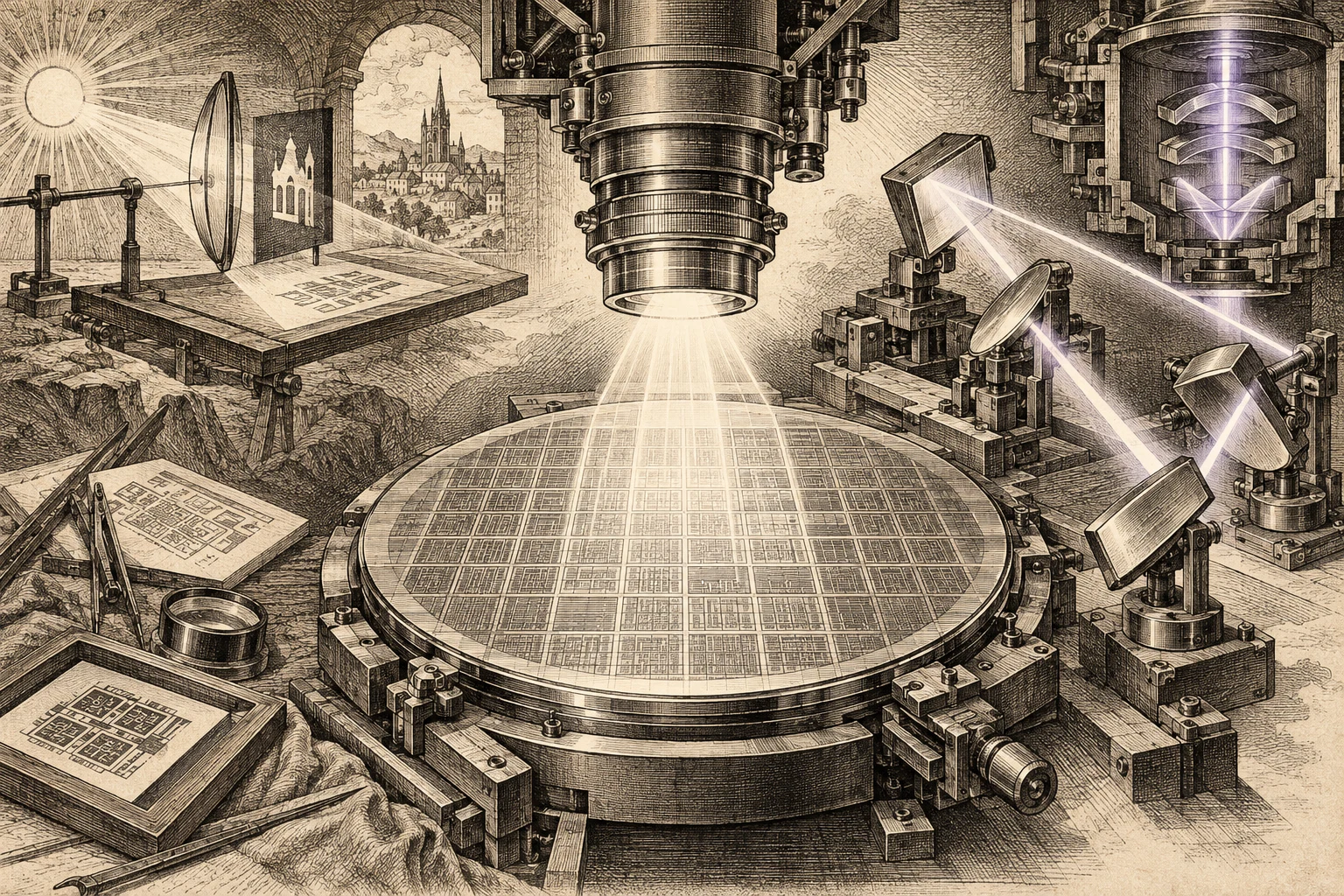
From Photolithography to EUV, How Have Chip Patterns Been Made Smaller and Smaller? Understanding the changes in lithography machines over the past seventy years by following exposure methods, light sources, and mass production milestones.
The payment button is pressed, but the order may not be completed. Starting with single payments from Green World and BlueNews, the process involves order creation, backend notifications, status queries, and official launch testing.
How to activate services only once after receiving payment notification? Use n8n or Make to connect orders, permissions, and mailing, and leave records for remedial actions such as resends, overdue payments, and missed orders.
Start by recording a practical operation, and use Guidde to organize the steps and narration; consider using Tella if you want to personally explain on camera. First, let the audience understand how to use the product.
Use Recraft to create illustration materials that can be extended into a series, and then use Canva to complete the layout. Starting with the first image, finalize the color scheme, design, and output format.
First, create a small website that allows contact, registration, or showcasing work. Use ChatGPT to organize content, Lovable to build pages, and then actually click each button.
Give the specifications, features, and customer questions to AI to write evidence-based product copy. The key is to select the right information and then change vague adjectives into specific descriptions.
First, define a question, then use a document question-and-answer tool to read the data and Perplexity to find clues. Include citations in the summary, and still check important conclusions against the original text.
How to turn a long text into an image? First, clarify the order, category, and cause and effect. Then, use Napkin AI to create a draft and put it back into the presentation to check if it is truly easy to read.
The logo is done, but the business cards, packaging, and website all look different? Starting from common scenarios, organize the files, rules, and templates that brand identity needs to deliver.
Before building a website, clearly list the information visitors want to find, the copywriting and images, the forms and processes, and the maintenance personnel. These preparations will directly affect the design, schedule, and pricing.
"Professionalism, innovation, and quality" are not enough to define who you are best suited for. Write down the brand positioning that can be used to introduce your services based on the client's problems, alternative options, and delivery evidence.
Are you copying and pasting, fixing formulas, and rechecking numbers every week? First, trace the data source of the report, handle column and version issues, and then decide which steps are worth automating.