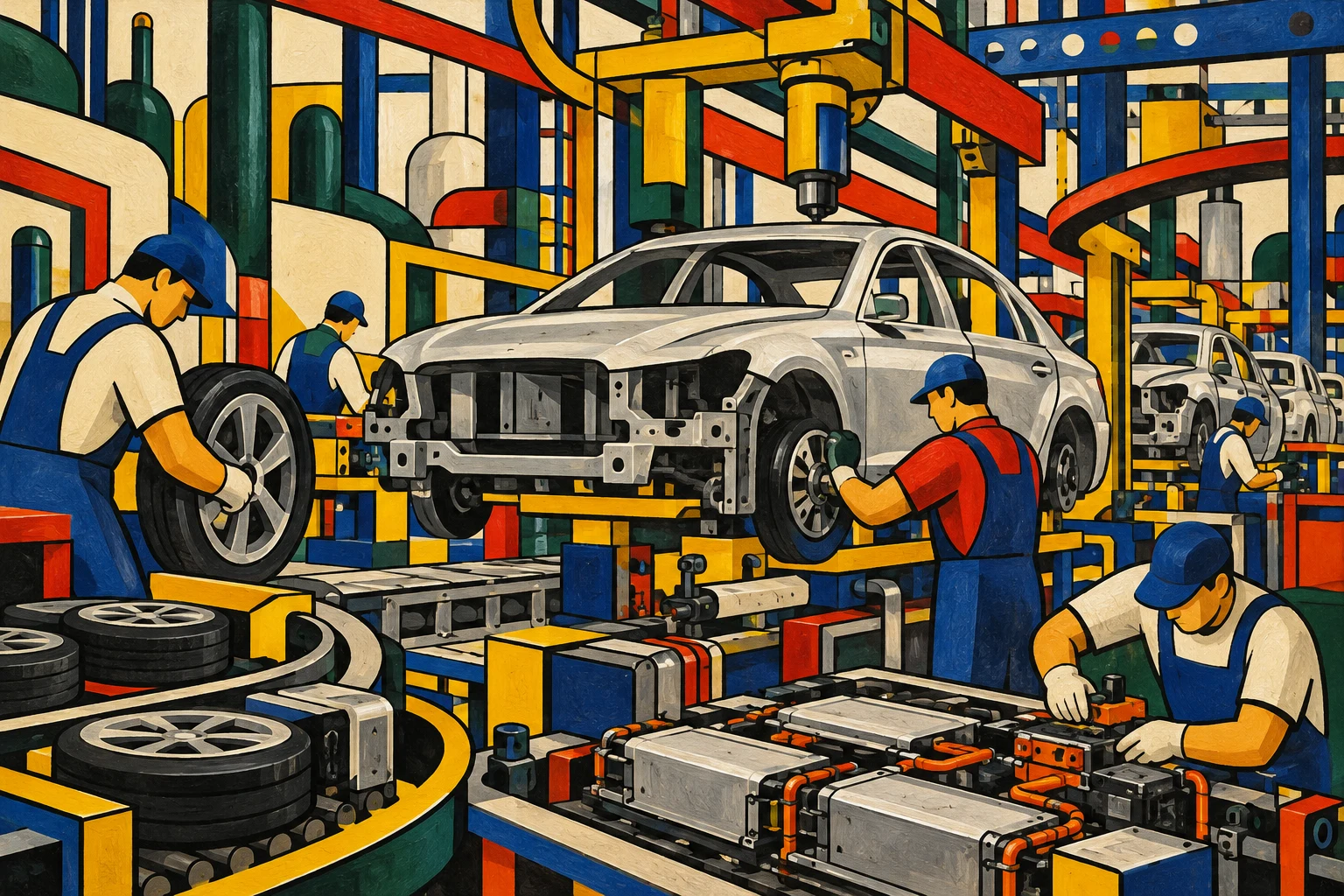
Disassembling a car reveals the division of labor
Seat adjustment, cabin quietness, brake control—these seem like separate functions, but they work together in a car. The automaker determines the specifications and integrates verification, while suppliers deliver systems, parts, materials, or software separately.
Tier 1 refers to the first-tier suppliers that directly supply the automaker; further upstream are the sources of parts and materials. However, a company may supply multiple products simultaneously, making the actual network more complex than a single path.
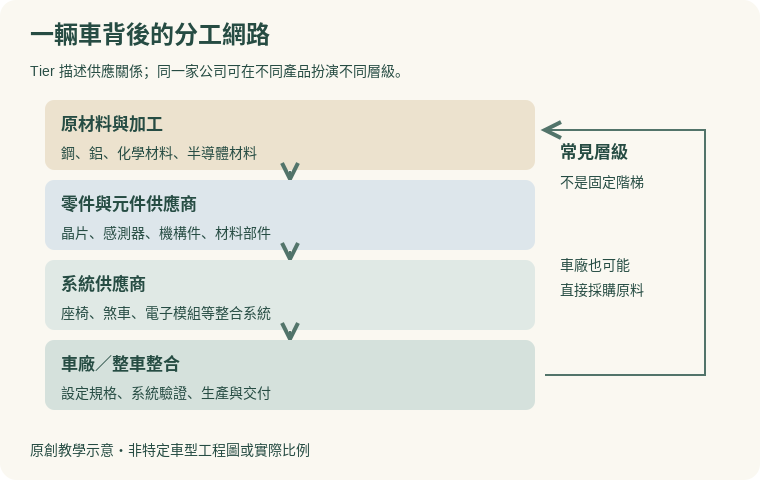
Mercedes-Benz publicly lists that its procurement, quality, compliance, and corporate responsibility teams jointly participate in supply chain management. When selecting suppliers, in addition to price, quality and upstream risks must also be evaluated.[1]
What details constitute visible luxury?
Disassembling a seat reveals foam, supports, adjustment mechanisms, motors, and electronic controls beneath the surface material. Support, comfort, space, and durability must be addressed together. This is a general system example, not a parts sourcing list for a specific model.
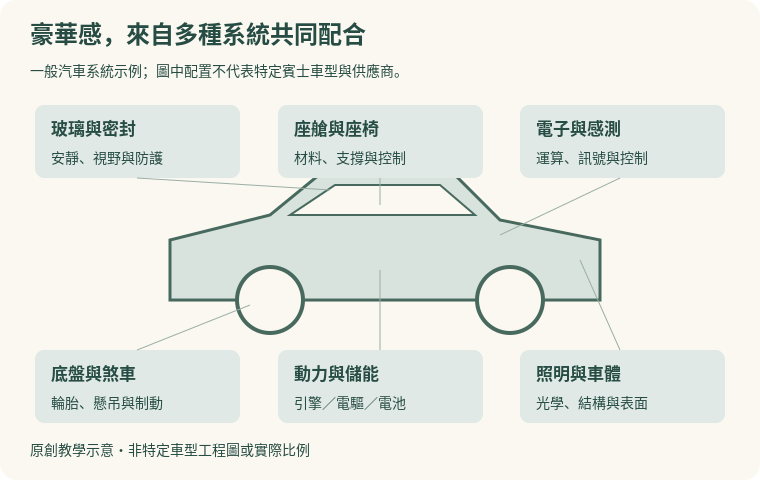
The quietness of the cabin also involves glass, sealing, sound insulation, tires, and the body. Lighting integrates optics, electronics, and heat dissipation. The result experienced by passengers spans many parts.
Even if two brands source from the same supplier, they may use different specifications, structures, and software tuning. Same sourcing does not necessarily mean the same user experience.
Public collaboration with automotive semiconductors
The following retains the announcement year and selects several cooperation examples to illustrate the division of labor. These are not immediate procurement lists and cannot be used to determine the configuration of each vehicle.
| Partners and Data Year | Cooperation Level | Key Reading Points |
|---|---|---|
| Bosch/1978 | Electronic Control ABS | Historical examples of collaboration with Mercedes-Benz; this does not mean that braking systems from all eras came from the same supplier.[7][8] |
| NVIDIA / 2020 Announcement | In-vehicle Computing and Software Architecture | The announcement outlines the direction of collaborative development; however, the specific functions and scope of implementation will depend on vehicle models and market data.[5] |
| CATL et al / 2022 Announcement | Battery Cooperation Network | The publicly available information at the time listed partners such as CATL, ACC, Envision AESC, and Farasis; this is not equivalent to a parts list for a single vehicle model.[3] |
| Rock Tech / 2022 Agreement | Battery-grade lithium raw material supply | Explains automakers' layout in the raw material sector; contract signing and actual delivery progress should be viewed separately.[4] |
The "cooperation" mentioned in the announcement could refer to development direction, supply agreements, or projects already in mass production. Leaving the stage and year next to the case study will prevent it from being interpreted as the current configuration of all car models.
Chips: Beyond advanced processes, there are also control and power applications
Chips in automobiles have many functions: processors handle computation, microcontrollers perform control, sensors provide status information, and power semiconductors participate in energy conversion. ST's electric vehicle technology data lists microcontrollers, gate drivers, silicon and silicon carbide power components as different application categories; this is used to illustrate industry technology and does not mean that ST is a supplier for the Mercedes-Benz model mentioned in the article.[9]
The statement "using a few nanometers of chip" only answers part of the question. Computation, power control, and sensing each face different requirements in terms of voltage, temperature, response time, and reliability, and therefore require different manufacturing processes and packages.
Assuming the control module is missing a verified component, delivery cannot be completed even if all other parts are present. Alternatives must pass electrical, software, and testing conditions; identical appearance is not sufficient.
Electrification: From battery packs to materials
From raw materials, processing, and electrode materials to cell, battery pack, and vehicle integration, these are different levels. Some designs do not go through traditional modules, so seeing a "battery factory" requires checking which segment it actually produces.
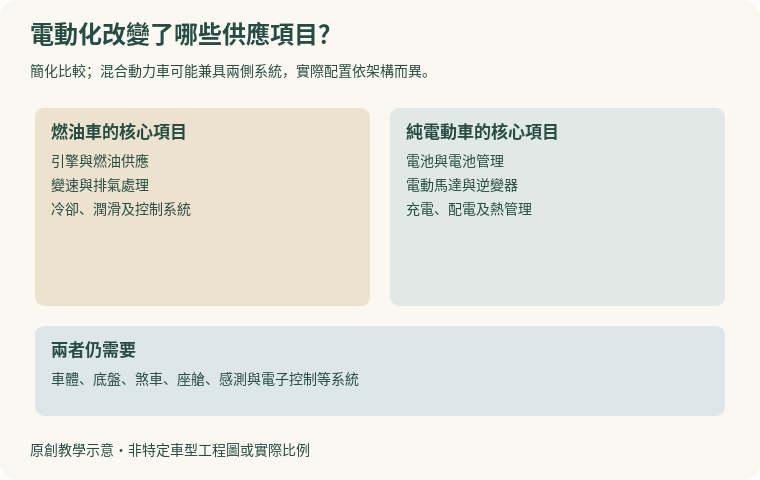
Mercedes-Benz's Bibb County battery factory, serving nearby vehicle production, is an example of the connection between battery systems and vehicle manufacturing. This type of localized configuration, along with the upstream cell and material sourcing, needs to be understood separately.[6]
The 2022 Rock Tech agreement is an example of automakers arranging sourcing for battery-grade lithium. The signing event is recorded here; whether the original supply schedule has been fulfilled requires further investigation.[4]
Tracing upstream, also tracking improvement
Mercedes-Benz's Responsible Sourcing Standards cover working conditions, human rights, environment, safety, and business ethics, and require direct suppliers to communicate these requirements to their suppliers. This is an institutional arrangement that extends brand requirements upstream.[2]
Regarding mineral sourcing, the company explains that it uses reporting tools to identify smelters and refineries in the supply chain and checks whether they meet relevant assessment standards. This also reminds us that tracing materials requires tracing across multiple companies and processing stages.[10]
Supply standards provide requirements, and reporting tools leave clues for verification. Whether it truly reduces risk depends on what problems are discovered, how they are subsequently improved, and whether the data is updated.
Making commitments to every vehicle
The sourcing and configuration of the same brand can vary depending on the model and year. Whether parts arrive on time, whether specifications are verified, and whether the software is compatible all affect the final experience.
The logo is centralized in one location, but the manufacturing process is distributed across the entire network. Understanding the supply chain allows you to connect familiar brand images back to specific divisions of labor.
Sources and Further Reading
- Mercedes-Benz: Supply Chain Management and Supplier Evaluation ↗
- Mercedes-Benz: Business Partners and Responsible Procurement Standards ↗
- Mercedes-Benz: 2022 Canada Memorandum of Understanding and Battery Collaboration Network ↗
- Mercedes-Benz: Rock Tech Lithium Supply Agreement (October 20, 2022) ↗
- NVIDIA: Announcement of Computing Architecture Collaboration with Mercedes-Benz (June 23, 2020) ↗
- Mercedes-Benz: Battery Plant in Bibb County, USA ↗
- Bosch: Development and Mass Production of Electronic ABS ↗
- Mercedes-Benz: Safety Technology Milestone Collaboration with Bosch ↗
- STMicroelectronics: Semiconductor Applications in Electric and Hybrid Vehicles ↗
- Mercedes-Benz: Due Diligence on Conflict Minerals ↗
- MoMA: Fernand Léger Retrospective and Style Introduction ↗