1886 to 1888: The Automobile on the Road
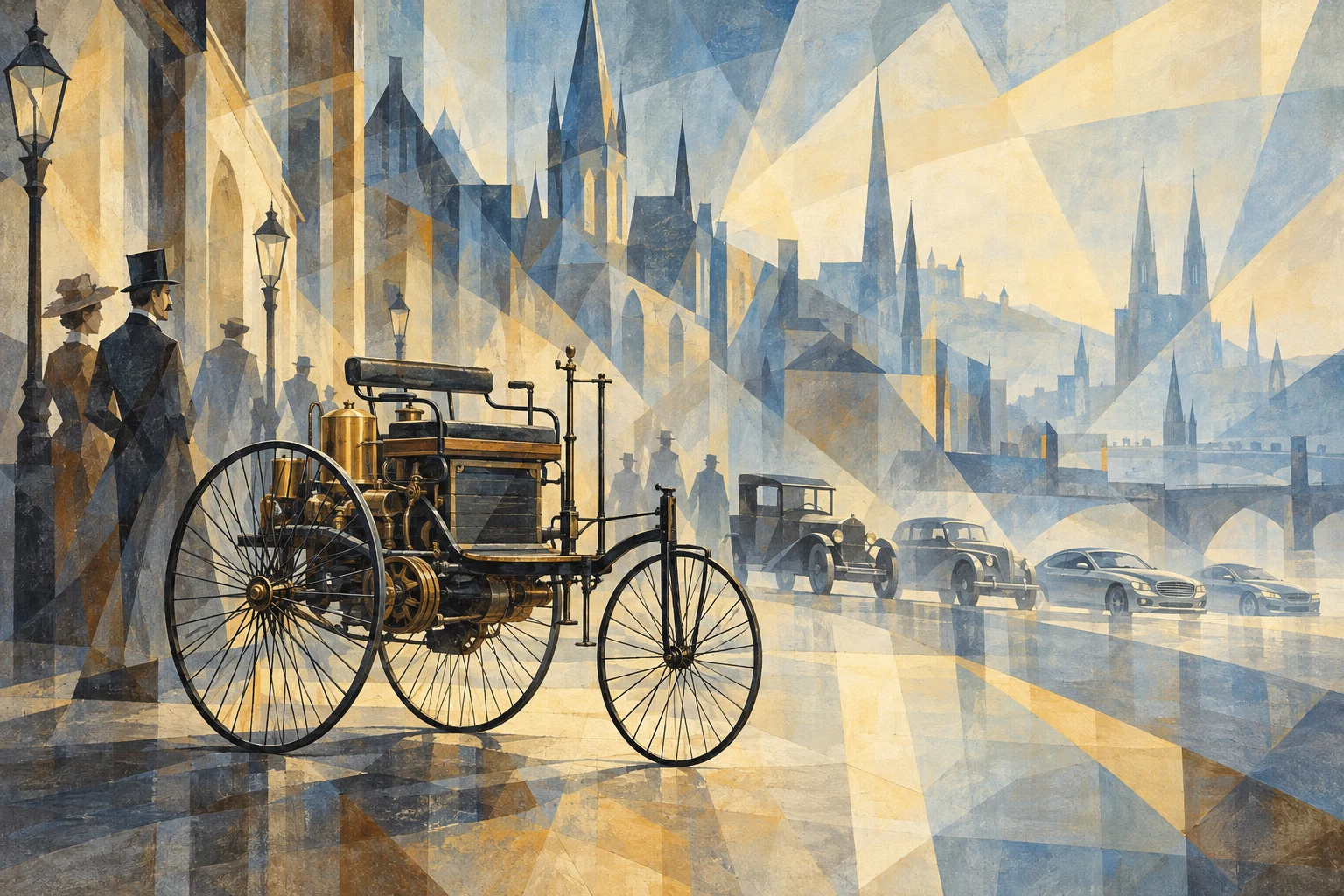
In 1886, Carl Benz introduced a gasoline-powered three-wheeled automobile. Meanwhile, Gottlieb Daimler and Wilhelm Maybach were developing lightweight engines and powered vehicles. The starting point was still to make vehicles move without horses, and there was no product lineup as we know it today.[1]
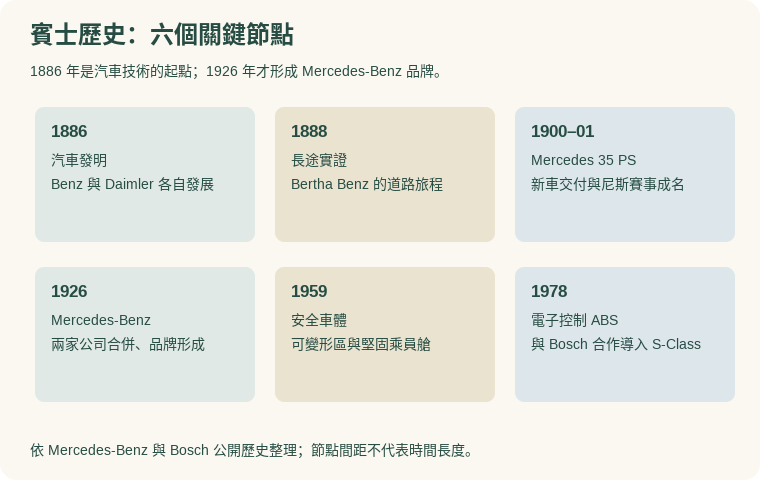
Benz and Daimler never met in person, each pursuing their own businesses. Their company histories converged in 1926, forming the Mercedes-Benz brand.[1]
1888: Bertha Benz Takes His Invention to the Road
In 1888, Bertha Benz, with his two sons, drove from Mannheim to Pforzheim. Along the way, he had to handle refueling and other issues; without a network of gas stations, pharmacies became his fuel source.[2]
Where to refuel and whether the road was long enough were the questions that brought cars into practical use. This journey left behind the problems that inventions encounter once they enter daily life.
The Name and Formation of Mercedes-Benz
The name Mercedes comes from the daughter of businessman and racing enthusiast Emil Jellinek. Jellinek's performance requirements spurred the development of the new car. The Mercedes 35 PS was delivered in 1900 and achieved success at the 1901 Nice race.[3]
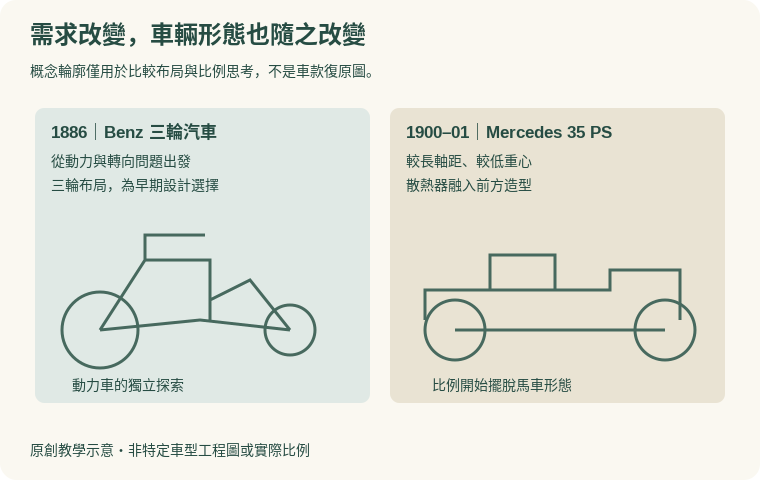
The Mercedes 35 PS changed its center of gravity, wheelbase, and radiator, gradually moving away from the proportions of a carriage. This shows how the car's shape adjusted to meet mechanical needs.[3]
1926: Two Histories Converge into Mercedes-Benz
Daimler-Motoren-Gesellschaft and Benz & Cie. merged in 1926 to form Daimler-Benz, using the Mercedes-Benz brand. This name simultaneously preserved Mercedes' market identity and the founding legacy of Benz.[3]
The three-pointed star comes from the Daimler system, originally intended to connect to the application of engines on land, water, and air. The logo has continued, and this early technological vision has remained in the brand's memory.[1]
Wartime: Corporate Responsibility You Must Read Together
During the Nazi era, Daimler-Benz increased production of military trucks and aircraft engines, and used forced laborers including abducted civilians, prisoners of war, and concentration camp inmates. This corporate history needs to be read alongside its engineering achievements.[4]
According to the company's official history, nearly half of its employees in 1944 belonged to the aforementioned forced labor group. After the war, the company acknowledged its relationship with the Nazi regime and participated in initiatives to assist former forced laborers. The brand narrative cannot overlook the experiences of these people.[4]
Post-War Models and Safety Engineering
The 300 SL Gullwing sports car of 1954 was one of Mercedes-Benz's most iconic postwar models. In 1972, the 116 series debuted as the S-Class; the G-Class in 1979 and the 190/190 E in 1982 further showcased developments in terms of different uses and body styles.[5]
Post-war products expanded to sports cars, sedans, and SUVs, in varying proportions and for different purposes. Looking at these models reveals aspects that have been both preserved and continuously changed.
Safety Engineering: A Stiffer Body Isn't Always Better
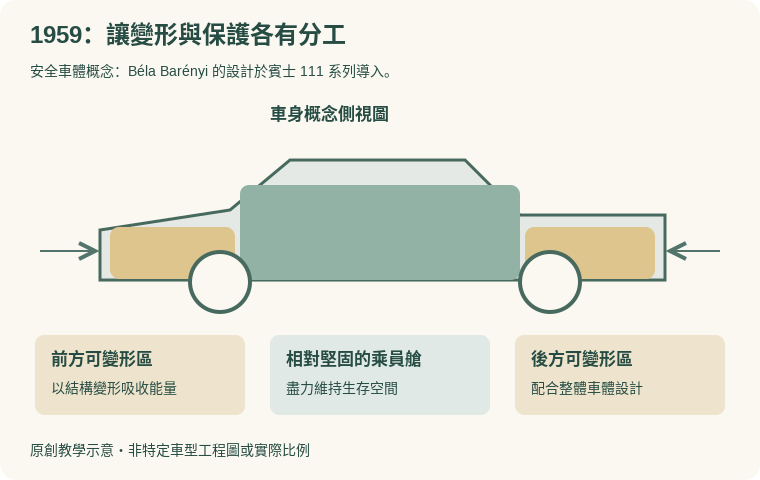
In 1959, the Mercedes-Benz 111 series adopted the safety body concept developed by Béla Barényi: a relatively rigid passenger compartment combined with front and rear areas that could be controlled to deform. During a collision, structural deformation can absorb some energy while striving to maintain the occupants' survival space.[6]
In 1978, the electronically controlled ABS, developed in collaboration with Bosch, was introduced to the S-Class. It reduced wheel lock-up by adjusting brake pressure, allowing steering capability to be maintained during emergency braking. This technology also reflects the importance of semiconductors and electronic controls in automobiles.[6][7]
Safety design integrates materials, structure, sensing, and control. How to absorb energy during a collision and how to maintain control during emergency braking both require a complete system and testing.
Brand History, Ultimately Returning to Each Generation of Products
Inventions and classic car models have built up a sense of familiarity with the three-pointed star. Safety engineering, styling, and user experience have given this symbol concrete meaning across different eras.
Today's electric and digital systems still need to be tested in practice. Looking at the supply chain will also reveal which roles contribute to this product experience.
Sources and Further Reading
- Mercedes-Benz: The Starting Point of Automobile Development, 1886–1920 ↗
- Mercedes-Benz: Bertha Benz and the Long Journey of 1888 ↗
- Mercedes-Benz: The Formation of the Mercedes Name and Brand ↗
- Mercedes-Benz: The Nazi Era, 1933–1945 ↗
- Mercedes-Benz: Historical Representative Models ↗
- Mercedes-Benz: Safety Body and Technological Milestones ↗
- Bosch: The Development of Electronic Anti-lock Braking Systems ↗
- MoMA: Lyonel Feininger's Life and Style ↗