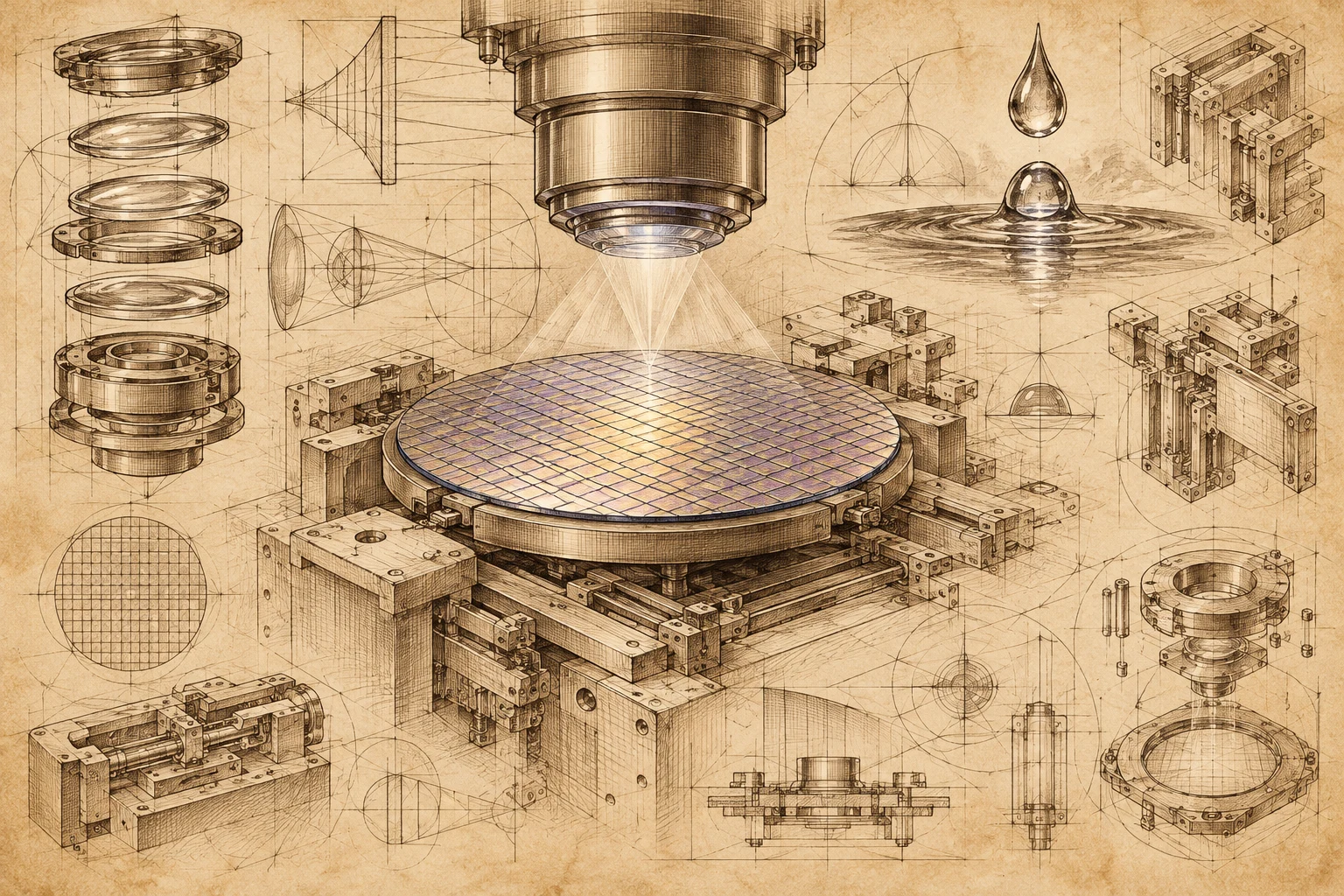
Where to begin reading a patent?
Searching for "ASML patents" may yield multiple results for the same invention: different countries, application publications, and approval announcements, all leaving behind documents. Put the number of results aside for now; choosing a publication number makes it easier to get started.
Note the applicant or assignee, priority, and family, then check the version. The definition of family varies; the number of search results cannot be directly equated to the number of inventions.
[4]This article selects three US patent approval notices with ASML Netherlands B.V. as the original assignee, examining platform positioning, liquid space, and light source debris respectively. These examples do not represent all patents and cannot be used to determine the configuration of currently sold machines.
Find the problem from the abstract, then go back to the request terms to see the conditions.
First, find the problem from the abstract and drawings, then go back to the request terms and read the conditions one by one. Taking Article 84 of the European Patent Convention as an example, the request terms must define the matter for which protection is sought; the objective in the abstract still needs to be grounded in specific features.
[6]The following will first discuss the problem, then the method, and finally point out the conditions in the request terms. The diagrams are separate conceptual illustrations; please refer to the original diagrams and complete text in the respective sections.
Case 1: The platform needs to move accurately.
PATENT DOCUMENT
US7352149B2
Method for controlling the position of a movable object, a positioning system, and a lithographic apparatus
- Original assignee
- ASML Netherlands B.V.
- US Application Publication
- US20080054838A1 · 2008-03-06
- U.S. Approval Notice
- US7352149B2 · 2008-04-01
Problem to be solved:The platform needs to move quickly while suppressing positional errors. This document discusses how the two motors should divide their functions, taking into account heat generation and control complexity.
Methodology of the document:Two different types of motors operate on the same degree of freedom. One set calculates feedforward control based on the reference signal, and the other set provides feedback based on the difference between the reference position and the actual position.
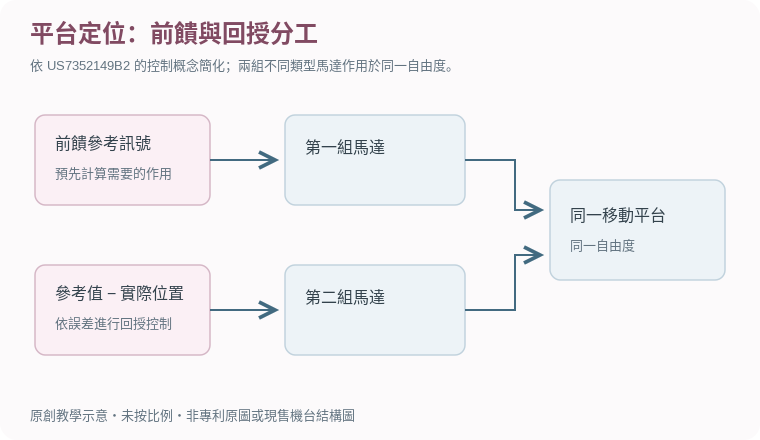
Compare with the patent claim: Two different types of motors, the same degree of freedom, and the sources of feedforward and feedback signals are all in the conditions. When reading, list these characteristics, and don't just leave the words "feedforward and feedback".
[1]Case 2: Water needs to stay in the right place.
PATENT DOCUMENT
US8248577B2
Lithographic apparatus and device manufacturing method
- Original assignee
- ASML Netherlands B.V.
- US Application Publication
- US20060250601A1 · 2006-11-09
- U.S. Approval Notice
- US8248577B2 · 2012-08-21
Problem to be solved:Immersion exposure uses liquid, but its extent must be controlled. The size of the liquid space affects issues such as wafer edge crossing and bubbles.
Methodology of the document:Liquid is used to constrain the structure and surface geometry, limiting the liquid near the exposure area. The geometric conditions must be considered together when reading this document; it cannot be simply summarized as "keeping the water in place."
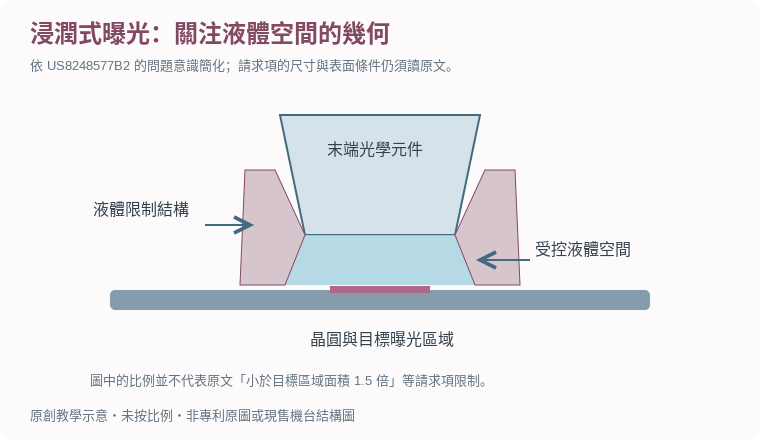
Compare with the patent claim: Request 1 includes conditions such as tilted surfaces, specific planar cross-sections, and areas smaller than 1.5 times the target area. This ratio applies to this request and cannot be used to generalize about all immersion devices.
[2]Case 3: Issuing EUV while controlling debris.
PATENT DOCUMENT
US10588211B2
Radiation source having debris control
- Original assignee
- ASML Netherlands B.V.
- US Application Publication
- US20160278196A1 · 2016-09-22
- U.S. Approval Notice
- US10588211B2 · 2020-03-10
Problem to be solved:Luminescent plasma can also generate debris, which may affect components. The document attempts to obtain control clues from plasma images.
Methodology of the document:The imaging device acquires plasma images, and the controller then adjusts system components based on the image characteristics to reduce the adverse effects of debris.
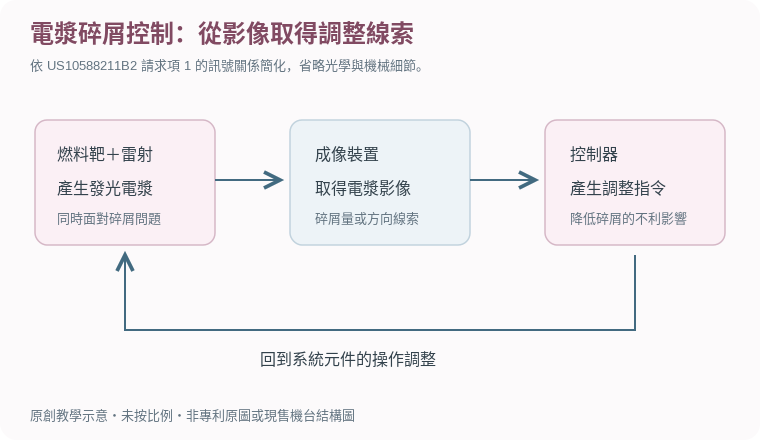
Compare with the patent claim: Claim 1, in addition to fuel, laser, imaging, and controller, is also connected to imaging characteristics related to debris quantity or direction. The key is how the image is used for control, not just the camera itself.
[3]If you want to continue searching, you can follow this order.
- Locate the document using the publication number:Read the three documents above first to confirm the version, don't just rely on similar titles.
- Extend the applicant and keywords:For example ASML Netherlands, stage positioning, liquid confinement, debris control.
- Look at the family and citations:Track related applications, prior cases, and subsequent improvements; being cited does not mean that others have used the technology.
- Verification procedures and registration information:For cases in the United States, the records can be found at the USPTO Patent Center; for other regions, the records should be checked with the relevant competent authority.
Verify the approval record, current status of rights, and existing rights holders separately. This article only interprets the published technology and does not determine whether these rights are currently valid, freely usable, or already installed in a product.
Further investigation can be conducted by examining these three questions to find related information and citations: how is the location controlled, how is the liquid contained, and how are debris reduced? Only by returning to specific conditions can one see where subsequent documents have improved.
Public documents and extended sources
- US7352149B2: Platform Positioning Control, Request and Publication Documents ↗
- US8248577B2: Immersion Liquid Space, Request and Publication Documents ↗
- US10588211B2: Plasma Debris Control, Request and Publication Documents ↗
- EPO: Patent Family ↗
- EPO: Espacenet Search and Document Tool ↗
- EPO: Article 84 of the European Patent Convention, Request ↗
- USPTO: Patent Center Official Case Search ↗
- The Met:Leonardo da Vinci ↗