
Before quoting a price, define the scope of the project
One requirement only lists "registration, login, member page", while another requires regular deductions, expiration suspension, cancellation of renewal, and customer service order tracking. The appearance may be similar, but the number of situations to be handled behind the scenes is much greater.
Therefore, before quoting a price, the operation and rules need to be broken down. AI has created several pages of visuals, which only illustrate part of the progress; data, integration, testing, and handover must be included in the scope of work item by item.
Breaking down from project name to the first draft scope
The table below lists several common types. First, circle the necessary processes, then look to the right at the tasks that are easily overlooked.
| Project Types | Common Needs | Easily overlooked details |
|---|---|---|
| Brand Website, Portfolio | Service Introduction, Case Studies, Contact Form, SEO | Mobile Version, Image Speed, Content Update Method |
| Event Registration System | Sessions, Quotas, Waiting List, Notifications | Duplicate Registration, Simultaneous Quota Grabbing, Cancellation and Replacement |
| Membership and Subscription System | Registration and Login, Membership Levels, Service Permissions | Forgot Password, Expiration Processing, Account Deactivation |
| E-commerce and Payment System | Products, Shopping Cart, Orders, Payment | Inventory synchronization, refund, and resending payment notifications |
| Reservation and Scheduling System | Available time slots, staffing, reminders | Time slot conflicts, rescheduling, cancellation, and time zones |
| Customer Management System | Customer data, inquiry records, follow-up status | Repeat customers, data permissions, inbound and outbound transfers |
| Internal Administrative System | Leave, expense reimbursement, approval, document management | Proxy approval, return for modification, operation records |
| Inventory and Asset Management | Inbound and outbound, inventory count, borrowing and returning | Simultaneous changes, quantity tracking, damage and loss |
| Reports and Dashboards | Data integration, indicators, filtering, charts | Indicator definition, update frequency, missing data |
| AI Knowledge Assistant | File search, summary, Q&A, source citation | File version, access permissions, answer verification |
| Automated connection | Data synchronization, notification, status update | Repeated triggering, execution failure, retry and redo |
For example, "reservation" also requires deciding on conflicts, cancellations, and rescheduling; "members" also require account retrieval and expiration processing. These rules are marked as pending until confirmed.
Break down the workload from the operation
Taking event registration as an example, the requirements can be written to this extent:
Participants can select a session, fill in their name and email. After the system confirms there are still spots available, it saves the registration record and returns the registration number. When the quota is full, processing stops, and duplicate records cannot be added during the same retry submission.
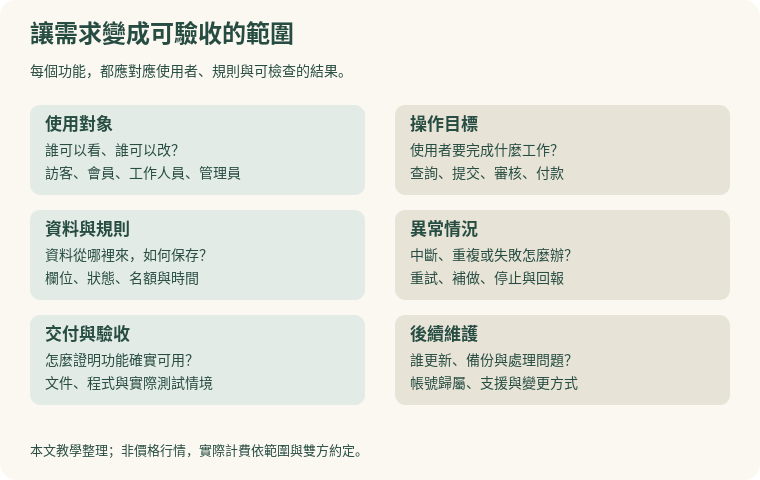
This way, it's possible to know who operates, what data is sent, what restrictions are followed, and what is seen upon success. During acceptance testing, the same description can be used for actual operation.
| Requirements | Content to be Confirmed |
|---|---|
| Who will use it? | Visitors, members, staff, or administrators. |
| What needs to be accomplished? | Query, create, modify, review, or make payments. |
| What documents are needed? | Fields, data sources, associations, and storage methods. |
| What are the limitations? | Permissions, quotas, time, and status. |
| How to handle failure? | Duplicate submissions, interruptions, errors, or external service failures. |
| How to accept it? | Which scenarios must be actually completed? |
| Who will maintain it? | Who updates the content, manages the account, and handles issues? |
Before AI organizes the fields and specifications, the rules should be confirmed by someone familiar with the business. Especially in cases of cancellation, refund, or reaching the limit, the tool should not be allowed to make decisions automatically.
Quotations should not only be based on page count.
A one-page registration form can only collect names, or it can simultaneously verify membership, collect payments, control quotas, and issue vouchers. The number of pages remains the same, but the number of systems that need to be connected and the number of failure scenarios have increased.
| Work Items | Contents |
|---|---|
| Requirements and Planning | Interviews, process organization, specifications and acceptance criteria |
| Design and Content | Visuals, layout, workflow, copywriting and materials |
| System Development | Front-end, Back-end, Database and Management Interface |
| External Integration | Payment, Mail, Login, Existing Systems or APIs |
| Testing and Deployment | Functions, Permissions, Abnormal Processes, Deployment Settings |
| Handover and Maintenance | Operation Instructions, Account Transfer, Backup and Follow-up Support |
If interviews, data supplementation, or reorganization of existing processes are required, these should also be included in the deliverables, not hidden in the "Website Development" project.
How can we combine five billing methods to meet our needs?
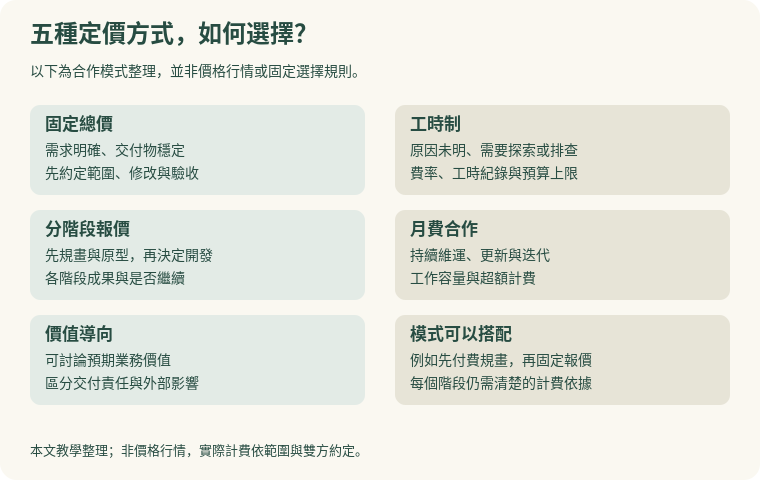
If the requirements are clear, the total price can be discussed; if problems still need to be investigated, set a time limit or phase limit first. The following is a billing model, not a price list. Planning can be done first for the same project, and then development can be estimated separately.
| Pricing Model | How to Calculate | Suitable Situations | Should be agreed upon first |
|---|---|---|---|
| Fixed Total Price | Quote a price based on a clear scope | Stable demand, clear deliverables | Functional scope, number of modifications, acceptance and change methods |
| Working hours | Calculate based on actual hours invested | Troubleshooting, modifying existing systems, exploratory work | Rate, working hours record, budget limit and return frequency |
| Phased pricing | Pricing is done separately for planning, prototyping, development, and launch | Larger scale, or needs still need verification | Stage deliverables, payment milestones, and continuation status |
| Monthly fee cooperation | Monthly provision of agreed-upon service volume | Continuous updates, maintenance, and feature iterations | Workload, priority, response time, and excess costs |
| Value-driven pricing | Negotiating based on expected commercial value and delivery responsibility | Clear performance objectives and reasonable value assessment | Evaluation benchmarks, influencing factors and delivery boundaries |
Fixed Total Price
When demand is stable, the total price facilitates budget allocation. Pages, functions, material providers, number of modification rounds, and additional billing items should all be included in the quote.
Write the scope of modifications as actionable conditions: which characters and graphics can be replaced, how many confirmations are needed, and when to finalize the draft. If a different payment or management system is added, reassess the situation to avoid treating new features as general fixes.
Working hours
When taking over an old system, it's often necessary to first read the code and reproduce the errors to understand the extent of the problem. This type of exploratory work can be charged based on actual hours worked.
First, set an upper limit for investigation hours. After investigation, submit the problem, options, and estimates before deciding on the next step; work hour records should reflect specific work and outputs.
Phased pricing
When ideas are still evolving, complete the planning or prototype first before deciding on formal development. The first phase delivers the process, fields, and prototype; the next phase focuses on the main functions and integration.
At the end of each phase, usable results should be available. If it's decided not to continue, how documents, designs, and programs will be handed over should also be agreed upon before starting.
Monthly fee cooperation
After launch, continuous content updates, bug fixes, or minor feature adjustments can be supported using a monthly fee.
The monthly fee should specify capacity, response time, overage allowance, and emergency support. Modifications to existing forms and additions to subscription features should not be simply glossed over as "website updates."
Value Orientation
The value of some projects comes from reducing manual processing, minimizing errors, or making it easier for customers to complete operations. Fees can be discussed based on these goals.
For example, if the goal is to reduce manual processing, the steps to be improved and how to measure them can be agreed upon. Results such as revenue, which are influenced by the product and market, should be clearly stated separately, along with shared responsibilities.
How is the cost reflected when using AI?
Generating programs and images is only part of the work. Understanding requirements, debugging, integration, communication, and delivery also take time.
Hourly rates are calculated based on the agreed-upon actual input, while fixed-price rates are based on the scope of delivery. Which algorithm to use should be clearly stated before cooperation to avoid changing the algorithm halfway through.
When discussing costs, reconcile the time saved with the delivery: Was the project duration shortened? Was testing increased? Was more usable content obtained? If not, you can also ask what inputs were included in the original quote.
Continuing Fees and Subsequent Expansion
Domains, hosts, databases, storage, emails, SMS, AI and external APIs, payment, platform subscriptions and maintenance may not be included in the one-time development fee. Clarify who will pay for each item.
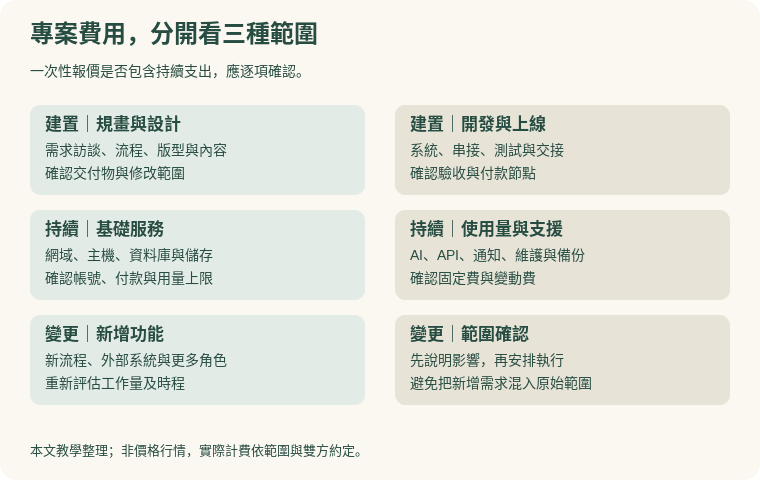
Some are fixed monthly, some increase with usage. Also specify who applied for the account, whether there is a limit, and whether it can be transferred upon termination of cooperation.
If the system itself will charge users, define the number of users, the amount or usage measurement method, and how to handle exceeding the limit.
Taking event registration as an example, first circle the first version.
Assuming the first version only requires event introduction, forms, data saving, and backend list, complete these four items first. Other requirements are estimated separately:
| New Requirements | Additional Processing Required |
|---|---|
| Online Payment | Order status, payment notification, failure and refund process |
| Waiting List | Sorting Rules, Notifications, Response Deadlines, and Quota Reservation |
| Member Login | Identity Verification, Account Management, and Data Access |
| Automatic Email Delivery | Templates, Delivery Records, Retry, and Service Fees |
| Multiple Organizers | Data Segregation and Management Access for Different Organizers |
For each added item, clearly explain which rules and systems it affects. First, implement the necessary processes, and then expand them according to usage. Budgets and changes are also easier to track.
Once you've read the quote to the end, you should be able to begin the acceptance process.
Objectives, scope, deliverables, excluded items, material responsibilities, schedules, payment methods, and change orders must all align with the actual work.
Reconfirm how the program and data will be delivered, who owns the account, where maintenance will be handled, and who will bear the costs for third parties.
Have both parties explain "how completion is defined." If the answers differ, add the discrepancies to the specifications before starting production.