
The story of materials often begins with a step that is not done well.
Exposure is too insensitive, pattern edges are not smooth, or the surface is damaged after grinding. These process problems lead researchers back to the material: Can the reaction be changed? Can known components be combined in a different way? Can the original material be used for other purposes?
Public reviews show that there are usually multiple rounds of experiments between finding clues and stable production. Before a bottle of material enters the factory, it must be proven to be effective, and it must also be known what will cause it to fail.
Chemically amplified photoresist, early research on Inpria, and CMP formulations each leave different clues.
IBM: After improving sensitivity, failures still need to be addressed.
The starting point for chemically amplified photoresist is to increase the material's sensitivity to exposure. Hiroshi Ito's research review records that IBM proposed this concept in 1980: let the exposure first produce acid, and then use the acid to catalyze a series of chemical transformations within the material.
Taking an acid-catalyzed system as an example, exposure first produces acid, and then the catalytic reaction extends the effect. The reaction is limited by diffusion, deactivation, and processing conditions, and cannot be scaled up indefinitely.
[1]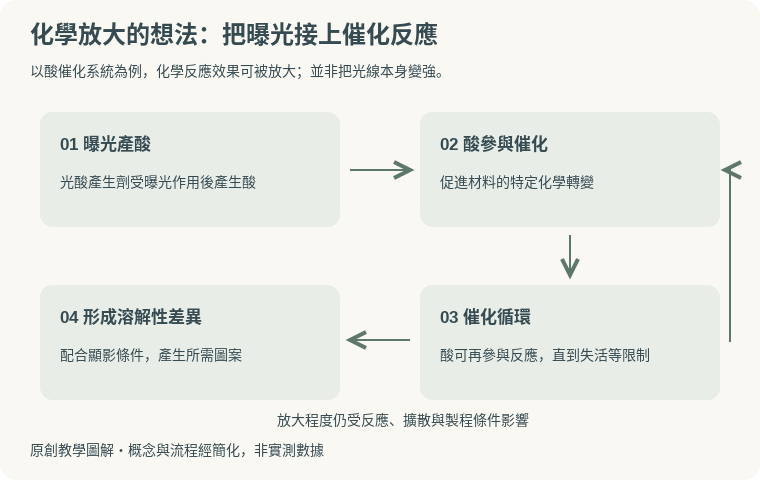
By the mid-1980s, related photoresists had been used in IBM's 1 Mbit DRAM. From concept to application, researchers had to integrate exposure efficiency and pattern formation into the same reaction design.
[1]After the first success, air may also become a problem.
Being able to form patterns in the laboratory does not mean that the process is stable. Another review by Ito points out that the subsequent development of positive 248 nm photoresists encountered serious post-exposure delay problems.
Researchers traced the problem to alkaline substances in the air contaminating the photoresist surface and further developed a more environmentally stable system. This experience shows that the performance of a formulation can also be altered by processing intervals and changes in the surrounding environment.
[2]This failure brought attention to air and time, which are beyond the materials. Once the cause was found, the next round would know to adjust the formula or change the operating environment.
MOR: From smooth films to smooth pattern edges
Inpria's early research stemmed from a different problem shift. According to a review by Oregon State University, around 2005, Doug Keszler, John Wager, and HP collaborated to develop oxide electronic material inks capable of forming extremely smooth thin films.
With the films already smooth, Keszler raised another question: could the edges of the patterns also retain this property? Jason Stowers used electron beam lithography experiments to shift the focus from thin film observation to imaging.
[3]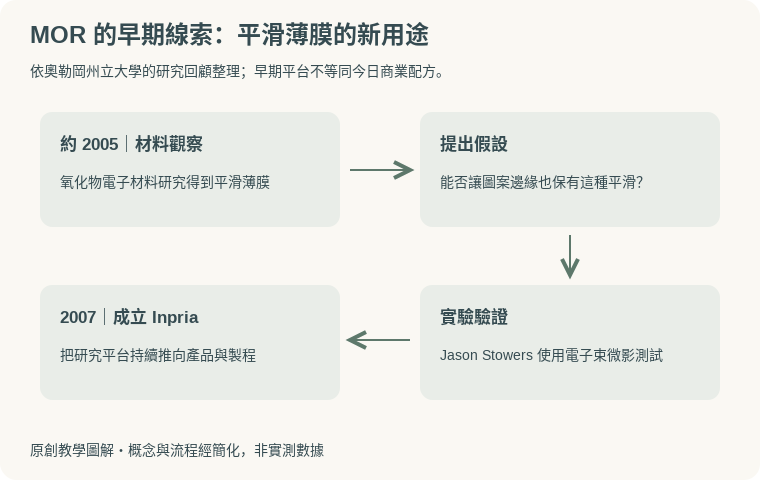
Inpria was founded in 2007 as a spin-off from university research. Early electron beam experiments supported materials science, which was not yet equivalent to the completion of today's EUV commercial formulations.
[4]The technology that Inpria now publicly presents utilizes organometallic molecular clusters with tin-oxygen cores. From early platform development to product manufacturing, continuous adjustments are made to the structure, imaging conditions, and manufacturing integration.
[8]CMP: Combining several known effects into materials that work together
The development of CMP is difficult to summarize as a single discovery of a particular chemical. For example, IBM's 1989 paper focused on combining reactive ion etching with CMP to address planarization under different patterning conditions. It was a case study of process integration and cannot be directly used as the invention date for all CMP materials.
[6]Regarding the polishing slurry itself, researchers compare the synergies and competition between components. A 2018 copper CMP experiment studied components such as colloidal silica, glycine, BTA, and hydrogen peroxide, and tracked the removal rate and surface roughness after the formulation was placed.
[5]| Research orientation | Questions I want to answer |
|---|---|
| Particles and Dispersion | Do the particles maintain a suitable state, or do they gradually agglomerate or settle? |
| Chemical Composition | Can the effect of promoting removal be balanced with corrosion control? |
| Processed Surface | When the removal speed is improved, does the surface quality also meet the requirements? |
| Placement time | Is the performance still stable immediately after formulation and after placement? |
Formulation studies need to find a usable range of conditions. Components affect each other after addition and may change after placement; therefore, researchers track both removal and surface results simultaneously.
From experimental results to reproducible production
First, confirm whether the result can be reproduced, then change the conditions to find the cause; only then do you measure the consistency of the complete processing flow, storage, and supply. These tasks are repeated back and forth, rarely completed in one go.
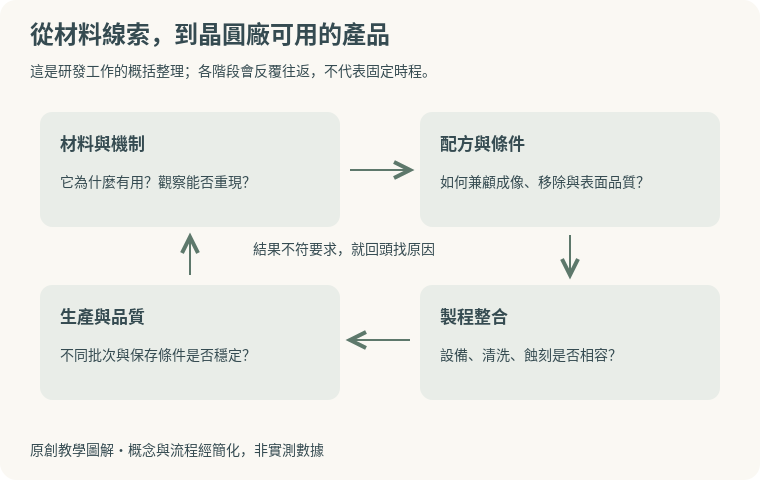
For CMP, Entegris' technical data discusses the grinding slurry, supply, filtration, grinding pad, and post-cleaning within the same system. This means that the formulation must be validated in conjunction with surrounding conditions, not just based on a single sample result.
[7]Inpria also incorporates quality control and statistical process control from raw materials to finished products into its production system. Good sample imaging is important, but consistency in the next batch of materials is also crucial for factory use.
[8]At what step does the "breakthrough" occur?
Chemical amplification and photoresist alter reaction design; early clues for MOR came from application transformation; and CMP continuously adjusts the combination of components and processes. Every advancement requires experiments to support the ideas.
When reading about breakthroughs, first identify whether the new technology is a structure, mechanism, formulation, or integration method, then examine the evidence to see which step in the material measurement, patterning, or actual process it represents.
Those failure conditions must also be documented. The clearer you understand which contamination, delay, or formulation change will ruin the results, the better you can ensure the stability of each subsequent batch.
Sources and Further Reading
- IBM Research/Hiroshi Ito: A Review of the Invention and Implementation of Chemically Amplified Photoresist (2003) ↗
- IBM Research/Hiroshi Ito: The Challenges from Laboratory Concept to Industrial Application (2008) ↗
- Oregon State University / Douglas Keszler: Oxide Thin Films, Electron Beam Verification, and the Origins of Inpria (2023) ↗
- Oregon State University: Jason Stowers and the Inorganic Photoresist Platform (2020) ↗
- Journal of Semiconductors: Copper CMP Formulation and Stability Experiments (2018) ↗
- IBM Research: Planarization Technology Combining RIE and CMP (1989) ↗
- Entegris: Integration of CMP Supply, Filtration, Grinding Pads, and Cleaning ↗
- Inpria: Existing Materials Technology, Production, and Quality Control ↗
- The Met: The Life and Painting Methods of Paul Cézanne ↗