Controlling Removal at the Polishing Interface
After copper fills the wafer trenches, there is still an overfill layer on the surface. CMP removes the excess, retaining the copper in the trenches while controlling the height of the surrounding material. This is an example of wafer planarization.
Repeated Material Deposition, Opening, and Filling Create Height Differences, but Subsequent Processes Require Controlled Surfaces. CMP stands for Chemical Mechanical Planarization, where chemical reactions and mechanical actions work together to remove material.
[1] [6]The optical mirror shaping described in the previous section must conform to the designed curved surface. Both perform surface processing, but their targets and material systems are still different.
What Do Polishing Fluid, Polishing Pad, and Equipment Do?
CMP involves moving the wafer and polishing pad relative to each other under controlled pressure, with a continuous supply of polishing slurry at the interface. The chemical composition alters the reaction state of the material surface, while the particles and polishing pad participate in contact and material removal; both effects influence the final result.
[1] [2]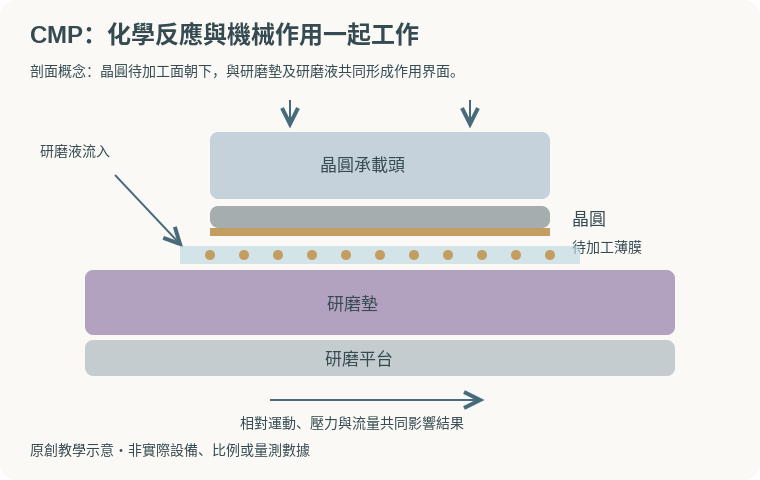
The composition of the grinding slurry must be compatible with the surface reaction. The hardness, porosity, compressibility, and grooves of the pad material will also affect the processing results. Without considering the pad material and equipment conditions, the formulation is difficult to evaluate in isolation.
[2]Particle and Chemical Composition Coordination
After silicon dioxide or cerium oxide particles are added to the formulation, they must interact with the film and additives. Even with similar particle sizes, the reaction and dispersion characteristics may differ, and re-verification is necessary before substitution.
For example, in STI (Shallow Trench Isolation) oxide layer polishing, different material routes can be seen. Fujifilm has publicly introduced silicon-based polishing slurries, indicating that cerium oxide is not the only option for this type of application. It's not enough to simply remember "a certain process must use a certain particle size"; the overall formulation and stop layer requirements must also be considered.
[3]In addition to average particle size, attention should also be paid to small amounts of large particles or agglomerates. Solution supply, filtration, and monitoring are essential to maintaining the usability of the formulation when it reaches the wafer surface.
[2] [8]Chemical additives: some promote removal, some inhibit corrosion.
Taking a partial copper CMP formulation as an example, studies have shown that colloidal silicon dioxide, hydrogen peroxide, glycine, and benzotriazole (BTA) are responsible for polishing, oxidation, misalignment, and corrosion inhibition, respectively. This is only a combination from publicly available studies and not a common formulation for all products.
[4]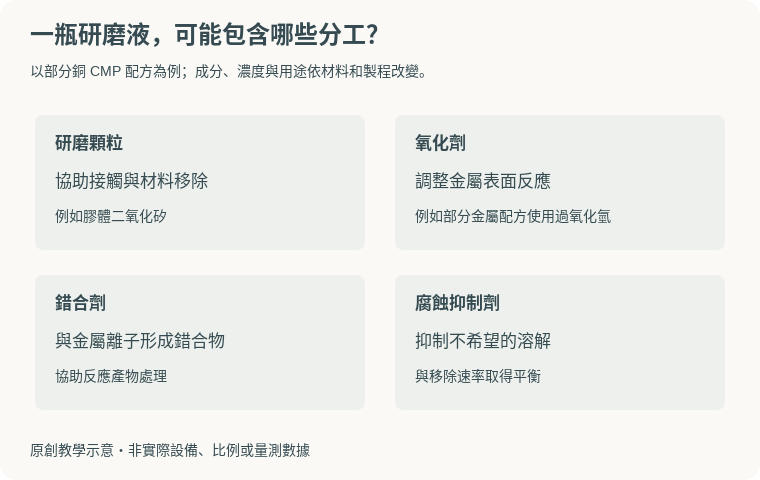
The formulation promotes the reaction while inhibiting unwanted corrosion. Oxidants, misaligners, and inhibitors each play a role, with the goal of removing the surface as needed, rather than intensifying the reaction.
If removal is accelerated but leaves roughness, corrosion, or residue, it is still not a good result. The composition and concentration must be verified against the target material and actual conditions.
[5]The Polished Surface Still Needs Cleaning and Monitoring
Different materials often coexist on the surface of a wafer. The so-called selectivity ratio is a comparison of their removal rates under specified conditions; engineers want to control the impact on barrier layers or dielectric layers when removing the target layer.
Copper CMP products therefore discuss removal capability, selectivity for barrier layers, and dishing and erosion. The former can be understood as the depression of the metal area, while the latter involves the loss of overall surface height of the patterned area; these are not the same thing.
[6] [7]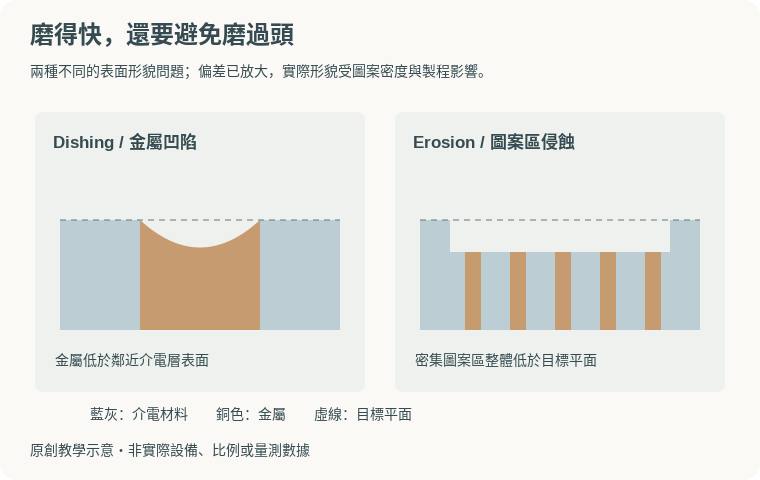
As the speed increases, simultaneously check for uniformity within the wafer, and for scratches, depressions, or residue. Listing these results together prevents surface problems from being masked by a single removal rate.
Cleaning and Monitoring: Grinding Isn't Over Yet
Grinding particles and organic residues may remain after processing. Post-cleaning materials must be compatible with the chemical properties of the grinding slurry to remove contaminants while also considering surface material properties. Changes in concentration, flow rate, and particle size during the slurry supply process also need continuous monitoring.
[2]If the interconnect material changes, the original formulation must be re-verified. Entegris, when discussing molybdenum-related processes, addressed grinding slurry, filtration, and concentration control together, illustrating how material changes affect surrounding processes.
[8]From Wafers to Advanced Packaging, Demands Continue to Expand
CMP also appears in material handling for advanced packaging. Fujifilm's packaging grinding slurry introduction covers heterogeneous integration and 3D packaging applications; these applications also focus on material removal, surface quality, and compatibility between different materials.
[9]| Observation Items | What questions can be asked when reading technical documents? |
|---|---|
| Processing Object | Is it copper, oxide layer, barrier layer, or other materials? |
| Removal Capability | Under what conditions are speed and selectivity measured? |
| Surface Quality | Are scratches, dents, and pattern area erosion controlled simultaneously? |
| Process Stability | Are the polishing pad, liquid supply, filtration, and cleaning verified together? |
The morphology left after polishing is the surface that the next process will deal with. Speed, selectivity, and defects all ultimately come back to this result for evaluation.
Sources and Further Reading
- Fujifilm: CMP Polishing Materials and Chemimechanical Effects ↗
- Entegris: CMP Materials, Polishing Pads, Filtration, and Cleaning ↗
- Fujifilm: Front-End Process Polishing Fluids and Silicon-Based STI Materials ↗
- Journal of Semiconductors: Composition and Stability Study of Copper Polishing Fluids (2018) ↗
- Microelectronic Engineering: Research on Copper CMP Wedges and Inhibitors ↗
- Fujifilm: Overfill Removal, Selectivity, and Defect Requirements for Copper CMP ↗
- Applied Materials: 2026 Master Class, Schematic Diagram of CMP and Surface Morphology on Slide 44 ↗
- Entegris: The Influence of New Metallic Materials on CMP Formulation and Monitoring ↗
- Fujifilm: Advanced Packaging CMP Polishing Fluids ↗
- The Met: Georges Seurat and Neo-Impressionism ↗